eCommerce GEO: How Online Shops Get Cited by AI Search

Most GEO advice is written for a blog. An online shop has product pages and a review count instead of bylines, and standard checklists skip them. Only 3.2% of shopping searches trigger an AI Overview at all. Most AI-visibility budget belongs on third-party review presence and clean product data, not more articles. We took one client’s ecommerce site from 727 to 6,370 monthly organic visits in seven months using exactly that mix.
Key takeaways
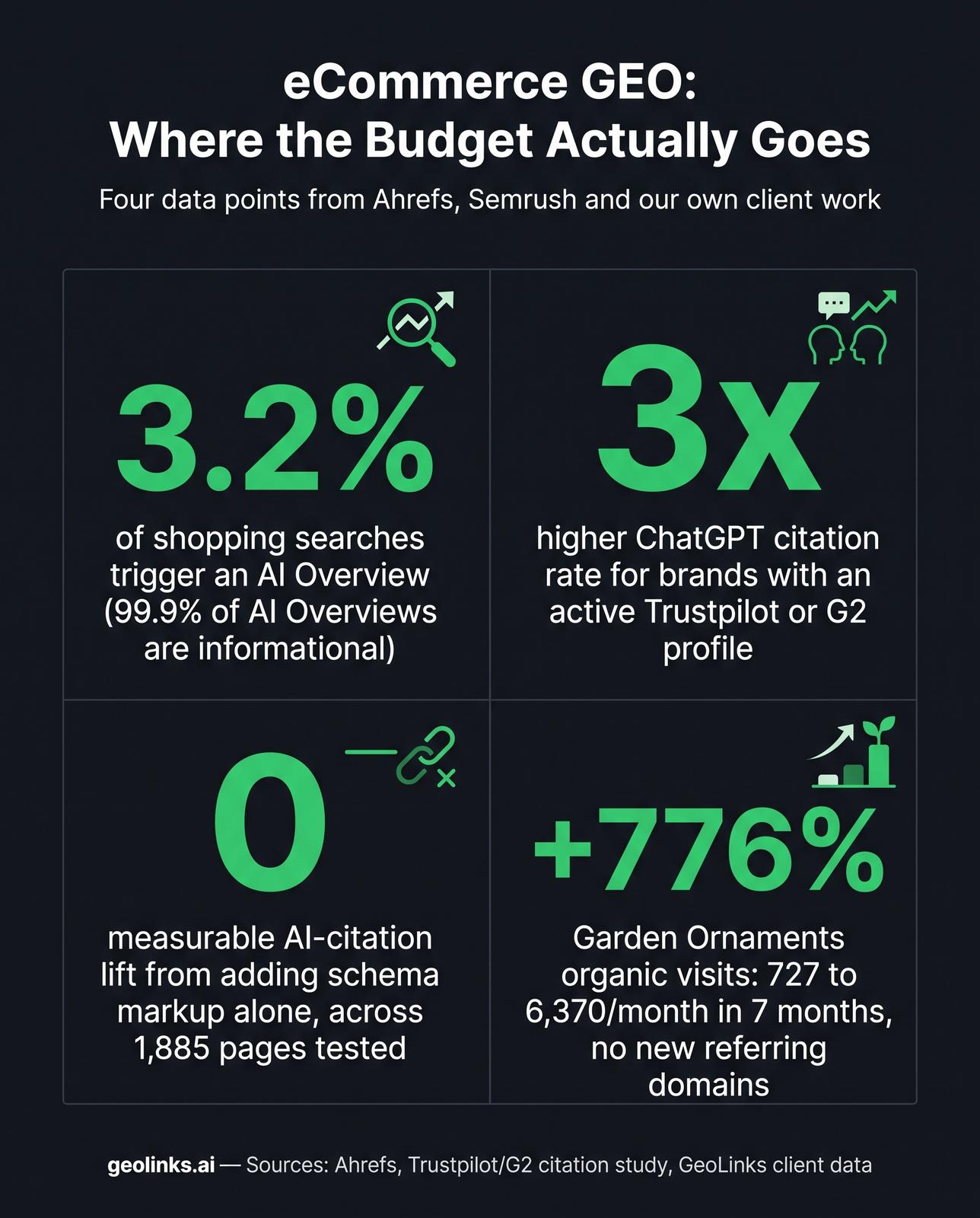
- Only 3.2% of shopping searches trigger an AI Overview; 99.9% of all AI Overviews are informational, per Ahrefs. Product-page fundamentals matter more than volume of blog content.
- Product schema alone does not lift AI citations. Ahrefs tested 1,885 pages and found no significant increase from adding structured data by itself.
- Brands with an active Trustpilot, G2 or Capterra profile get roughly 3x the ChatGPT citation rate of brands with no review-platform presence.
- Shopify and Etsy catalogues already feed ChatGPT’s organic shopping discovery with no setup. A separate Ads Manager feed covers paid placement and other engines.
- We took Garden Ornaments from 727 to 6,370 monthly organic visits (+776%) in 7 months, October 2025 to May 2026, without adding a single net-new referring domain.
Why generalist GEO advice leaves ecommerce sites behind
Every GEO checklist we have reviewed this year starts from the same template: write authoritative content, get quoted in roundups, fix your FAQ schema. That template was built for service businesses and publishers. An ecommerce site’s highest-traffic pages are product listings and category grids, not articles, and those pages compete on a different signal set: price accuracy, availability, review volume and structured attributes. A handful of ecommerce-specialist agencies have started building service pages and data partnerships around this exact gap. The rest of the market still hands retailers the same blog-first checklist as everyone else.
Where the AI-visibility budget should actually go
The instinct is to spend AI-search budget on more content. The shopping-search data says otherwise. Ahrefs found that only 3.2% of shopping-intent searches trigger an AI Overview at all; the other 99.9% of AI Overviews that do appear are answering informational questions, not product ones. That does not mean shopping queries go unanswered by AI. ChatGPT, Perplexity and Gemini increasingly answer “best X for Y” and “where to buy” questions directly inside chat, outside the AI Overview box Ahrefs measured. It means the AI Overview format specifically is a poor budget target for a retailer, while chat-native shopping answers are the real prize.
| Query type | Share of shopping searches | Where the answer appears | What earns the citation |
|---|---|---|---|
| Direct product comparison (“best X under £Y”) | Majority of shopping intent | Chat answer, not AI Overview | Review volume, clear pricing, structured specs |
| Informational (“how does X work”, “is X worth it”) | Small share of total shopping queries | AI Overview or chat answer | Editorial content, buying guides |
| Navigational (“buy X near me”) | Remainder | Local pack, Shopping tab, chat answer | Feed accuracy, availability data |
Product-page signals that actually move AI citations
Two claims circulate about product pages and AI citations, and only one holds up under testing. Product schema, on its own, does not increase citation rates. Ahrefs ran a difference-in-differences test across 1,885 pages that added JSON-LD between August 2025 and March 2026 against 4,000 control pages, across Google AI Overviews, AI Mode and ChatGPT. Adding the markup produced no measurable citation lift on any platform. We covered the full study here: schema correlates with citation because well-run sites tend to have both, not because the tag itself changes anything.
Review-platform presence is the signal that does move the number. Brands with an active Trustpilot, G2 or Capterra profile get roughly 3x the ChatGPT citation rate of brands with none, based on May 2026 data. For a product page, that means the review count needs to sit on a page an AI engine can verify externally. A star widget embedded only on your own site carries no third-party corroboration.

The feed and structured-data reality
A product feed is infrastructure, not a GEO tactic on its own, but it is infrastructure most retailers already half-built for Google Shopping. Shopify and Etsy catalogues already feed ChatGPT’s organic shopping discovery with zero setup. Shopify’s Spring 2026 platform update opened its Catalog API and an Agentic Storefronts dashboard on its Agentic plan. It standardises product data (price, availability, attributes) so AI shopping agents can query it directly rather than scrape it. Retailers outside Shopify and Etsy can connect their existing Google Shopping feed to ChatGPT’s Ads Manager instead, refreshed up to every 15 minutes against a Google feed’s roughly 24-hour cycle. None of this replaces third-party review presence or clean category structure. It sits underneath both.
Shopify-specific execution
Most of our ecommerce clients run Shopify, so the practical checklist below assumes that platform, with the equivalent step noted for anyone else.
- Confirm your feed’s core fields are complete: id, title, description, availability, price and brand, whether it flows through Shopify’s native catalogue or a manually built Google Shopping feed.
- Connect the ChatGPT Ads Manager feed if you run outside Shopify or Etsy natively; Shopify and Etsy stores already have organic discovery switched on.
- Push review counts onto the product page itself, not just a third-party profile page, so both AI engines and shoppers see the same number.
- Rebuild category pages around single-claim sections (“best for small gardens”, “under £50”) rather than one long unstructured grid description, the same chunking discipline that earns citations on any page type.
- Keep availability and price fields current. A feed showing stale stock or price data is worse than no feed, since AI engines that cite it once and get it wrong stop trusting the source.

What we have seen on the ecommerce site we run
We took Garden Ornaments from 727 monthly organic visits in October 2025 to 6,370 by May 2026, a 776% increase in seven months, without adding a single net-new referring domain. The lift came from consistent product and category data, third-party review presence and editorial placements on pages already trusted in the niche, not from a paid feed connection or a schema overhaul. That is the same mechanism this guide describes, run on a live ecommerce catalogue rather than a hypothetical one.
Matt’s Pick: fix reviews and feed accuracy before touching content volume
If you run an online shop and you are choosing where to put the next month of GEO budget, review-platform presence and feed accuracy beat another round of blog posts. Get a Trustpilot or category-specific review profile live and pushing real numbers onto the product page itself. Confirm your Shopify or Google Shopping feed has complete core fields, then connect it to ChatGPT’s Ads Manager if you are outside Shopify or Etsy. Only after both are solid does category-page content and editorial placement work start moving the citation number further, the same niche-edit placements that produced the Garden Ornaments result. Run the free AI Visibility Check first if you want to see where your own catalogue currently stands.
Frequently asked questions
Does generic GEO advice work for ecommerce sites?
Not fully. Product and category pages need review-platform presence, feed data and structured pricing that a blog-first GEO checklist skips.
How much AI-search budget should an online shop spend on informational content versus product pages?
Most, on product and category pages. Only 3.2% of shopping searches trigger an AI Overview; 99.9% of AI Overviews are informational, per Ahrefs.
Does adding Product schema to a listing increase AI citations?
Not on its own. Ahrefs tested 1,885 pages and found no significant AI-citation lift from adding schema markup alone.
Do customer reviews affect whether ChatGPT recommends a product?
Yes. Brands with an active Trustpilot, G2 or Capterra profile get roughly 3x the ChatGPT citation rate of brands with none.
Does connecting a Shopify store to ChatGPT Shopping help organic AI citations?
Shopify and Etsy catalogues already feed ChatGPT’s organic shopping results with no setup. A separate paid feed covers other platforms.
What is the single highest-impact fix for an ecommerce site’s AI visibility?
Consistent product data plus third-party review and citation presence, not any one schema tag or feed connection.
Which AI engines matter most for ecommerce citations?
ChatGPT and Google AI Mode lead on shopping volume, but Perplexity, Claude, Gemini, Copilot and Grok all influence buyer research earlier in the journey.
Related reading
- ChatGPT Shopping now takes your Google Shopping feed covers the feed connection this guide references.
- Does schema markup help AI citations? The data is the full Ahrefs study behind the schema section above.
- Trustpilot and G2 presence triples your ChatGPT citation rate goes deeper on the review-platform data.
- Why ChatGPT cites one page and ignores another covers the chunking and structure rules category pages should follow too.
See the Garden Ornaments case study for the full ecommerce numbers, or check current pricing for the services referenced above.