Why 23.8% of ChatGPT's Top Citations Are Homepages
Ahrefs studied ChatGPT’s 1,000 most-cited pages and found homepages make up 23.8% of them, second only to Wikipedia. Most site owners spend their AI-visibility effort on blog content while their own homepage, the page they control completely, sits unready to be quoted. This piece sets out what cited homepages share, and the checklist we run against our own homepage while writing this.
Key takeaways
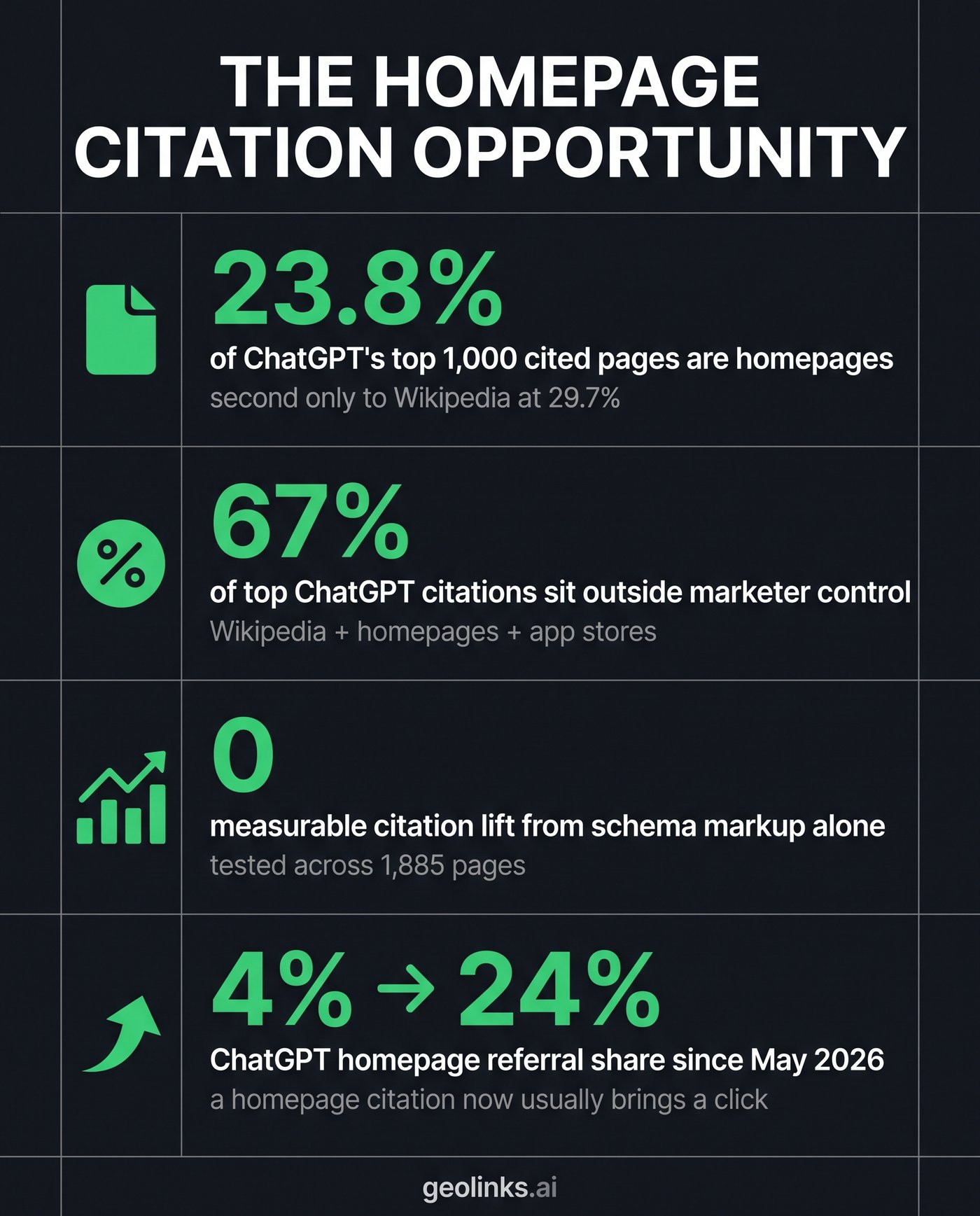
- Homepages are 23.8% of ChatGPT’s top 1,000 cited pages, the second-largest category after Wikipedia at 29.7%, per Ahrefs.
- 67% of those top citations sit in categories most marketers cannot influence directly: Wikipedia, homepages, and app store listings.
- Organization schema alone does not create a citation. Ahrefs tested 1,885 pages and found no measurable lift from adding markup by itself.
- ChatGPT’s homepage referral share jumped from about 4% to 24% after the 7 May 2026 branded-link update, so a homepage citation now usually comes with a click.
- Entity clarity, a citable summary paragraph, and named numbers move the citation rate. The schema tag is infrastructure, not the cause.
What Ahrefs actually found
Ahrefs pulled ChatGPT’s top 1,000 cited pages and sorted them by type. Two-thirds sit outside anything a marketer can directly build: Wikipedia articles, brand homepages, and app store listings. The remaining third splits across educational content, reviews, news and blog posts, the categories most GEO advice focuses on entirely.
| Page type | Share of ChatGPT’s top 1,000 citations | Can a marketer build one directly? |
|---|---|---|
| Wikipedia | 29.7% | No, only edit within Wikipedia’s own rules |
| Homepages | 23.8% | Yes, you already own it |
| App store listings | 6.6% | Only if you ship an app |
| Educational, reviews, news, blog | Remaining ~32.3% | Yes, standard content production |
Homepages sit in an unusual position on that list. They are off-limits to competitors trying to insert themselves, because ChatGPT already treats the brand’s own domain as the authoritative source for facts about that brand. That makes a homepage the one page in the top three categories a business fully controls.
Why some homepages get cited and most do not
A homepage earns a citation when ChatGPT can resolve it to a single clear entity with known, checkable attributes. We covered the page-level factor study behind this in detail: title alignment, content specificity, and clarity all rank ahead of raw authority. A homepage that opens with a vague mission statement gives the model nothing specific to quote.
Organization schema helps the model resolve who you are, but the tag itself is not the mechanism. We tested that directly across 1,885 pages that added JSON-LD markup and found no measurable citation lift from the schema alone. What correlates with citations is what the schema usually accompanies: a specific, named entity with consistent facts stated in plain text as well as markup. The tag documents the entity. It does not create the clarity.

Why this matters more since May 2026
A homepage citation is worth more than it used to be. Profound tracked ChatGPT’s 7 May 2026 branded-link update: homepage referral share of all ChatGPT traffic jumped from about 4% to roughly 24%, a six-fold rise, as the model started embedding brand homepage links inline far more often. A citation on your homepage today is far more likely to arrive with a click attached than it was five months ago. That raises the cost of leaving the page unready.
The citable homepage checklist
Run your homepage against these five checks before assuming the citation gap is content volume rather than the homepage itself.
- State the entity in one specific sentence near the top. Name what the business does, who it serves, and one concrete number, not a slogan.
- Add Organization and WebSite schema, and keep the name, description and URL consistent with every other profile that mentions the business.
- Name real numbers on the page itself, not just in a linked case study. A model quoting the homepage needs the fact to already sit there.
- Link the homepage to pages that corroborate the same facts internally, and make sure external profiles (LinkedIn, review platforms, directories) repeat the identical entity name and description.
- Avoid vague trust badges and unlinked award claims. A claim the model cannot verify is a claim it is less likely to repeat.

What we found checking our own homepage
We ran this checklist against geolinks.ai’s own homepage while writing this piece, since the whole point is that it is the one page we fully control. It already carries Organization and WebSite schema sitewide, plus Service and FAQPage schema on the homepage itself, and states specific numbers rather than vague claims: engagements from £1,250, managed retainers from £4,000 a month, seven supported citation datasets. The founders are named and linked to LinkedIn from /about/, satisfying the same entity-clarity test we are asking readers to apply to their own site.
One gap the audit did surface: the homepage headline rotates the engine name (ChatGPT, Claude, Gemini) for human visitors, which reads well in a browser but means a crawler taking a single snapshot of the rendered DOM only ever sees whichever name loaded first. We are leaving the rotor for the visual effect, but it is a reminder that anything a crawler needs to read reliably belongs in static text elsewhere on the page, not only in a script-driven element.
Matt’s Pick: fix the homepage before writing another citation-chasing post
If your AI-visibility plan is mostly new blog content, stop and check the one page you already fully control first. Add a specific entity sentence near the top, keep the name and description consistent everywhere the business is mentioned, and put real numbers directly on the page rather than one click away. Schema is worth adding because it documents the entity for the model, not because the tag itself buys a citation. Run the free AI Visibility Check to see whether ChatGPT, Claude, Gemini, Perplexity, Copilot, Grok or Google AI Mode already treat your homepage as a source before you spend the next month writing content instead.
Frequently asked questions
What share of ChatGPT’s top-cited pages are homepages?
23.8%, according to Ahrefs’ study of ChatGPT’s top 1,000 cited pages.
Why do homepages get cited more than most blog posts?
ChatGPT defaults to a brand’s own homepage when it needs one clear, authoritative source for that entity.
Does adding Organization schema to my homepage guarantee a citation?
No. Schema alone showed no measurable citation lift in Ahrefs’ own testing across 1,885 pages.
What actually makes a homepage citable?
Entity clarity, a specific citable summary, named numbers, and internal links that confirm the same facts elsewhere on the site.
Is a homepage citation as valuable as a blog post citation?
Often more. A homepage citation usually carries a direct link, and ChatGPT’s homepage referral share has grown sharply since May 2026.
Which pages make up the other 67% of ChatGPT’s off-limits citations?
Wikipedia leads at 29.7%, homepages follow at 23.8%, and app store listings add 6.6%.
How do I check if my homepage is already being cited?
Run it through GeoLinks’ free AI Visibility Check, which reviews all seven major citation datasets at once.
Related reading
- ChatGPT’s 7 May 2026 branded-link update covers why a homepage citation now carries more traffic than it used to.
- Why ChatGPT cites one page and ignores another is the 1.4M-prompt factor study behind the entity-clarity section above.
- Does schema markup help AI citations? The data is the full test showing schema alone does not move the citation rate.
- The UK GEO playbook covers the wider entity and authority signals UK brands need beyond the homepage.
Run the free AI Visibility Check on your own homepage, or see current pricing for the programmes referenced above.