How to Choose a UK GEO Agency: The Buyer's Framework

A weighted seven-criterion framework for evaluating any UK GEO agency, plus the twelve red flags that should kill a shortlist before the first sales call. Built from our May 2026 audit of fifteen UK GEO agencies and the buyer pain points that came out of forty-plus prospect conversations. Score every shortlist agency on the same template. Eight or more strong signals means credible. Five or fewer means keep looking.
Why choosing a GEO agency is harder than choosing an SEO agency
Generative engine optimisation is a young category in a noisy market. Three things make it harder to buy than traditional SEO:
The vendor landscape is split between credible SEO agencies extending into GEO and pure-play GEO brands with no track record. Both look the same on a landing page.
Pricing is opaque. Eleven of the fifteen UK GEO agencies we audited in May 2026 hide pricing entirely. The published prices that do exist span a 20x range, from £299 one-off to over £10,000 per month.
The terminology is fragmenting. GEO, AEO, LLMO and AI Overviews optimisation are now separate workstreams in some vendors’ offers and a single bucket in others’. Buyers cannot tell what they are getting.
The framework below cuts through all three. It is the same rubric we use internally and published in our Best UK GEO Agencies 2026 ranking. We score ourselves on it too. Use it as a buyer-side scorecard for every agency on your shortlist.
The 7-criterion framework at a glance
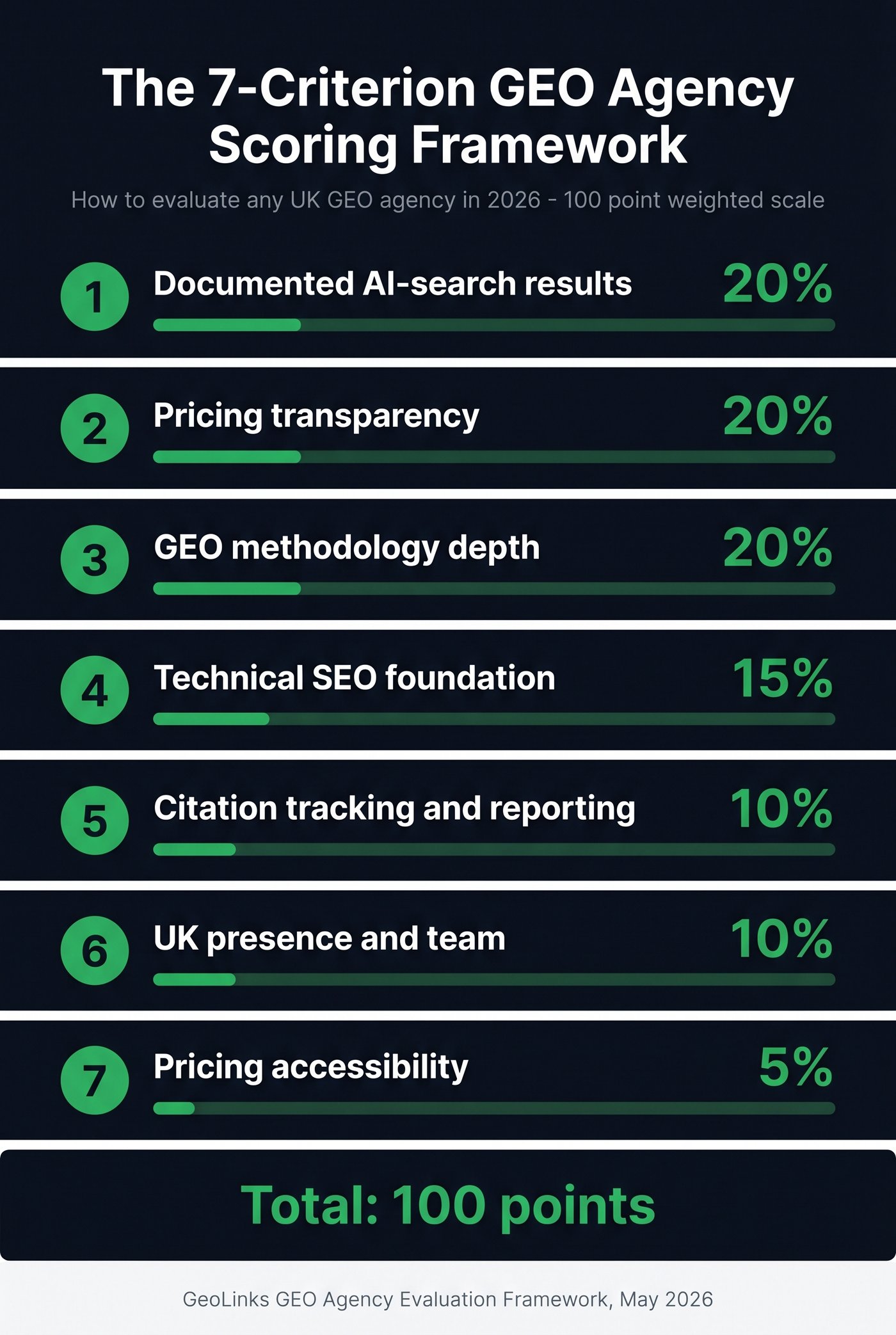
| # | Criterion | Weight | What you are scoring |
|---|---|---|---|
| 1 | Documented AI-search results | 20% | Named clients with named AI citation metrics |
| 2 | Pricing transparency | 20% | Tiered prices visible without an enquiry form |
| 3 | GEO methodology depth | 20% | Named framework, public process, multi-platform work |
| 4 | Technical SEO foundation | 15% | Crawl, schema, log files, indexation capability |
| 5 | Citation tracking and reporting | 10% | Per-platform measurement, owned tooling preferred |
| 6 | UK presence and team | 10% | UK-incorporated, UK delivery team, UK case studies |
| 7 | Pricing accessibility | 5% | Lowest entry point - one-offs and SMB tiers |
Each criterion is scored out of five and multiplied by its weight. Maximum total is 100. The weighting is the part most buyer guides skip. A vendor can be world-class on technical SEO and a zero on documented results; without weights, those scores wash out and the rubric tells you nothing.
The seven criteria explained
1. Documented AI-search results (weighted 20%)
The single most important thing to verify. A credible GEO agency publishes at least one named client with named AI citation metrics. Anonymous “20x LLM referrals” claims score half. Vague “appears in AI Overviews” claims score zero.
In May 2026 only four of the fifteen UK GEO agencies we audited publish named-client AI metrics. The bar is genuinely this low. Reboot Online publishes a finance client at +194.72% LLM-referred traffic. Yellowball publishes three named clients with specific metrics including Jager Freight (+100% AI Overviews appearances) and Blueberry Life (+7,700% top-10 keyword count). Polaris publishes an aggregate book at +527% AI-referred sessions year-on-year.
If an agency has zero named-client AI metrics on its site, ask why directly. The answer is usually that they have no proven AI citation work yet, which is fine as long as they price accordingly.
2. Pricing transparency (weighted 20%)
The criterion almost no buyer guide weights and almost no agency publishes. We weight it equal to documented results because hidden pricing is the strongest correlation we found in the May 2026 audit with weak methodology and weak case studies.
Score full marks (5/5) for tiered prices visible on the website without an enquiry form. Score three for ranges (£1,500-£3,000/mo). Score one for case-study-implied pricing. Score zero for “contact us”.
Eleven of fifteen UK GEO agencies hid pricing in our May review. GeoLinks publishes four offers, a £1,250 minimum and managed programmes from £4,000 monthly.
3. GEO methodology depth (weighted 20%)
What is their process? Can they name it? Is there evidence of work beyond rebadged SEO?
Full marks require a named framework, a public process document, and concrete evidence of LLM-specific work. Reboot’s AiPR framework is the cleanest example. Yellowball opens with “prompt research” as step zero (rare in the category). Found’s Luminr platform is owned tooling. The SEO Works publishes its education-led methodology in detail.
Score halves and zeros for agencies whose methodology pages restate the GEO definition without describing what they actually do.
4. Technical SEO foundation (weighted 15%)
GEO without SEO is theatre. AI assistants cite well-indexed, schema-rich, fast pages from real-traffic sites. An agency that cannot crawl your site, find your schema gaps, parse your log files, and fix your indexation is not equipped to deliver GEO outcomes.
This is table stakes for any agency that has existed for more than three years. Score 4-5 for established SEO heritage, 2-3 for credible but newer technical claims, 0-1 for agencies whose “technical” tab is a single paragraph.
5. Citation tracking and reporting (weighted 10%)
What do they measure across ChatGPT, Perplexity, Gemini, Claude, Copilot and AI Overviews separately? How often do they report? Is the tracking owned or rented?
A GEO agency tracking only ChatGPT is doing approximately 17% of the job. A GEO agency tracking “AI search” as one metric is doing zero work to differentiate between platforms with completely different citation source preferences.
Score 4-5 for per-platform measurement using owned tooling (Found’s Luminr, GeoLinks’ /check/ audit) or credible third-party stacks (Ahrefs Brand Radar, Profound, Peec AI). Score 1-2 for vague “we track AI mentions”. Score 0 if they cannot name the tool.
6. UK presence and team (weighted 10%)
UK-incorporated, UK delivery team, UK case studies. Check Companies House for the trading entity. A “London office” address on a website is not the same as a UK delivery team. Several agencies positioning for UK SERPs are actually delivered from offshore teams with a London accent.
Score 5 for Companies House-verifiable UK incorporation plus UK-based senior team plus UK client case studies. Score 3 for hybrid setups. Score 1 for offshore delivery with a London billing address.
7. Pricing accessibility (weighted 5%)
Lowest entry point on the price list. A £2,500/mo minimum excludes about 80% of the UK SMB market. A flat-fee one-off or a £899/mo starter tier widens the buyer pool.
We weight this lowest because small and large agencies diverge here for good reasons. A larger agency cannot economically serve a low-cost SKU. Buyers should still know the likely investment before committing to a sales process.
How to score an agency, with a worked example
Take an agency from your shortlist. Open their service page, pricing page, case studies page, about page, and methodology page in five tabs. Then run them through the rubric.
Worked example: scoring Yellowball from our May 2026 audit.
| Criterion | Weight | Raw score (out of 5) | Weighted contribution |
|---|---|---|---|
| Documented AI-search results | 20% | 4 (three named clients with specific metrics) | 16 |
| Pricing transparency | 20% | 3 (from £1,500/mo published, no full tiering) | 12 |
| GEO methodology depth | 20% | 4 (prompt research as step zero, no named framework) | 16 |
| Technical SEO foundation | 15% | 4 (credible technical claims, no log-file work mentioned) | 12 |
| Citation tracking and reporting | 10% | 3 (per-platform implied, tooling not named) | 6 |
| UK presence and team | 10% | 5 (UK-incorporated, named team, London delivery) | 10 |
| Pricing accessibility | 5% | 2 (£1,500/mo minimum, no one-off SKU) | 2 |
| Total | 100% | 70 / 100 |
Yellowball scores 70/100, which lands them at #7 in the May 2026 ranking. Strong on documented results and UK presence, mid-range on methodology depth, weak on accessibility for SMB buyers. If you are a London mid-market brand on a £1,500-£3,000/mo budget Yellowball is a credible candidate. If you are an SMB looking for a £500-£900/mo entry, the rubric tells you to look elsewhere.
Run the same exercise on every agency on your shortlist. Compare totals, not vibes.
The 12 red flags that should kill a shortlist
Some agencies are not worth scoring. If you hit two or more of these in the first ten minutes on the website, remove the agency from the shortlist.
- Vague ChatGPT visibility claims. “We get you cited by AI” with no named platform, no named client, no measurement methodology. This is the most common red flag in the May 2026 market.
- SEO rebadged as GEO. The service page lists “keyword research, content strategy, technical SEO” with the word GEO sprinkled on top. No mention of prompt research, no LLM citation tracking, no per-platform breakdown.
- No published case studies. Or “case studies” that are anonymised stat lifts with no client, no industry, no time period.
- Monthly minimums above £2,500 with no one-off option. Legitimate for enterprise-only agencies. A red flag if combined with weak case studies, because it signals a pricing floor designed to hide capability gaps.
- No LLM citation tracking stack named. Ask “what do you use to measure AI citations?” If they cannot name the tool or the methodology, they are not measuring it.
- “Editorial Team” or unnamed authors on blog content. Verifiable authorship is one of the six March 2026 Core Update gates. An agency selling GEO that fails the gates on its own site is a strong negative signal.
- Stock-photo author cards. Generic headshots, no LinkedIn, no Companies House. AI search engines and serious buyers both flag this.
- Generic “trust badges” with no detail. “5-star rated” with no source. “Industry leader” with no awards link. “Recognised by Google” without a partnership ID.
- Conflating AEO, GEO, LLMO and AI Overviews. Three or more conflations in the same article means they have not thought about the differences.
- No remediation policy for removed placements. A GEO agency placing links should have a written guarantee. Twelve-month replacement is current UK best practice. Silence on this is a billing problem waiting to happen.
- No published methodology beyond “we follow best practice”. Best practice is not a methodology. A named framework with a documented process is.
- “London office” without a UK Companies House record. Especially common with offshore delivery teams using a UK billing address. Check Companies House directly before any retainer signature.
Two flags and the agency comes off the list. One flag is worth asking about on the discovery call.
Pricing transparency: the criterion no other buyer guide uses
We weight pricing transparency at 20% because it correlates with every other criterion in the rubric.
In the May 2026 audit, every agency that publishes tiered pricing also has a named-client case study. Every agency that publishes only a price range also has at least one named case study. Of the eleven agencies that hide pricing entirely, only three have a single named-client AI citation case study. The other eight rely on logos, vague stat claims, and procurement-led sales motions.
The mechanism is not subtle. Agencies that hide pricing do it because their pricing is fragile to comparison. Either their product is undifferentiated and they need a sales call to anchor before quoting, or their pricing varies dramatically by client and they would rather not commit publicly. Both situations correlate with weak proof points elsewhere on the site.
The exception is enterprise-only agencies whose floor genuinely is £5,000+ per month and whose client profile genuinely cannot be served at lower price points. Found, Blue Array and Reboot Online sit here. They hide pricing for legitimate reasons. The other eight are doing something else.
Treat pricing transparency as a forced disclosure check. An agency that publishes prices is making a public commitment that is easy to audit. An agency that hides pricing is asking you to trust the discovery call. The first is information, the second is a sales motion.
The 12 questions to ask on every first sales call
Print this. Send it to every shortlisted agency in writing before the first call. Score their answers out of twelve.
- Can you name the LLM citation tracking stack you use? Vague answers usually mean a free dashboard or nothing.
- Which AI platforms do you measure citations on? A good agency tracks ChatGPT, Perplexity, Gemini, Claude, Copilot and AI Overviews separately, not as one metric.
- Do you run prompt research before content work begins? This is step zero. Skipping it means optimising for queries your buyers do not ask.
- Can you share at least one named-client AI citation case study? Anonymous “20x lift” claims do not count.
- What is your published pricing? A refusal to share pricing before a sales call is the single biggest red flag in this market.
- What is your average engagement length and minimum monthly spend? Beware monthly minimums above £2,500 that come with no flat-fee or one-off option.
- Do you distinguish between AEO, GEO, LLMO and AI Overviews optimisation? Three or more conflations means they have rebadged their SEO product.
- Who is the named lead on my account and what are their credentials? “Editorial Team” is not a lead.
- What is your guarantee or remediation policy if placements are removed? A twelve-month replacement guarantee is the current UK best practice.
- Are you UK-incorporated and where is the delivery team based? Check Companies House. “London office” is not the same as “UK delivery team”.
- Do you publish a re-audit or quarterly review cadence? Static reports are theatre.
- What is the smallest engagement you take on? Their floor tells you the buyer they are built for.
Eight or more strong answers means a credible shortlist candidate. Five or fewer means keep looking. We answer all twelve openly on our how it works page, pricing page, and the 12-month guarantee page.
The decision tree: match agency tier to your situation
The right agency depends on three variables: budget, internal SEO capacity, and required published-evidence threshold before you sign.
| Your situation | Budget | Use this tier | Agencies to shortlist |
|---|---|---|---|
| Enterprise with internal SEO leadership | £5,000+/mo | Enterprise full | Found, Blue Array, Polaris top tier |
| Established brand, no internal SEO lead | £2,500-£5,000/mo | Enterprise entry | Reboot Online, The SEO Works, Polaris |
| Mid-market, want SEO + GEO bundled | £1,500-£3,000/mo | Mid-market | Yellowball, Charle |
| Established brand, needs diagnosis before delivery | £1,250 one-off | Specialist diagnosis | GeoLinks |
| Defined one-off engagement, no retainer | £4,950 flat | One-off audit-and-fix | UK Linkology |
| Agency needing repeat fulfilment | From £4,000/mo | Private partner rate card | GeoLinks agency partnerships |
Match before scoring. There is no point comparing enterprise teams if your budget funds diagnosis only. Equally, a cheap supplier may not support a complex programme.
First-hand observation from forty UK GEO buyer conversations
We have run forty-plus prospect conversations with UK businesses considering a GEO engagement between January and May 2026. The same three questions come up every single time, almost always in this order.
First: “is GEO actually different from SEO, or is it just a rebrand?” The answer is yes and no. The signals overlap on technical foundation and authority. The work diverges on prompt research, entity association, chunk-level retrieval optimisation, and per-platform citation tracking. An agency that treats them as identical is selling SEO.
Second: “how do I know if your work is actually getting me cited?” The answer must be a named platform, a named tracking tool, and a published measurement cadence. If a vendor cannot answer this in concrete terms on the first call, they cannot deliver the outcome.
Third: “what does this cost?” In every single one of those forty conversations the prospect was visibly relieved when we shared the price within thirty seconds of being asked. The contrast with their previous shortlist (all of whom required a discovery call before pricing) was the most consistent positive signal we collected. This is not unique to us. Every UK GEO agency that publishes pricing earns a similar reaction from SMB and mid-market buyers.
The mechanism is trust compression. Hidden pricing forces buyers to invest hours in discovery before they know whether they can afford the agency. Published pricing lets them disqualify instantly and re-allocate the time to the shortlist that actually fits. Treat your own time accordingly.
Frequently asked questions
What is a GEO agency?
A GEO agency provides generative engine optimisation services: structured work to get a brand cited inside AI assistant answers from ChatGPT, Perplexity, Gemini, Claude, Copilot and Google AI Overviews. The discipline overlaps with SEO on technical foundation and authority signals but adds prompt-level testing, entity association, chunk-level retrieval optimisation, and multi-platform citation tracking.
How much does a UK GEO agency cost?
Published monthly retainers span roughly £1,500 to £10,000 or more. Credible diagnosis often starts near £1,000, while focused projects commonly start near £3,000.
What is the single biggest red flag when shopping for a GEO agency?
An agency that refuses to share pricing without a sales call. Eleven of the fifteen UK GEO agencies we audited in May 2026 hide pricing entirely. Combined with vague ChatGPT visibility claims and no published case studies, hidden pricing is the strongest signal a vendor has rebadged its SEO product as GEO.
Do I need a separate GEO agency or can my existing SEO agency do it?
Some SEO agencies can extend into GEO and most cannot. Ask whether they name their LLM citation tracking stack, run prompt research before content work, distinguish AEO from GEO from LLMO, and have at least one named-client AI citation case study. Three or more no answers means they have rebadged their SEO product.
How long until a GEO engagement shows measurable results?
Most credible UK GEO agencies quote three to six months before measurable citation lift across ChatGPT, Perplexity, Gemini, Claude, Copilot and AI Overviews. Faster results are possible in niches where AI assistants have no existing canonical source. Anyone promising under thirty days is almost certainly overpromising.
What questions should I ask on the first GEO agency sales call?
Ask which AI platforms they track separately, whether they run prompt research as step zero, what their published pricing is, whether they have a named-client case study, what their guarantee policy is, and what the smallest engagement they take on is. Eight or more strong answers out of twelve is a credible shortlist candidate.
Should I avoid agencies without published case studies?
Avoid agencies whose only proof is anonymised. Named clients with named metrics are the highest-trust signal in the May 2026 UK market. Four of fifteen UK GEO agencies we audited publish them. Anonymous lifts and vague AI Overviews claims are the noise the named ones cut through.
About the author
This guide is written by Matt Ward, founder of GeoLinks. Twenty-plus years building, ranking and selling on his own UK e-commerce sites including Greenhouse Stores (trading since 2012) and Garden Ornaments. Tens of millions in revenue, every line of SEO done in-house, every Google core update navigated since 2012.
- LinkedIn: profile link coming soon
- Email for corrections: hello@geolinks.ai
The full UK GEO market data behind this framework is published in our companion piece, the Best UK GEO Agencies 2026 ranking. Score corrections, omissions, and methodology challenges can be sent to the email above. We will respond and amend on the record.