Google's New Search Console AI Report: The UK Guide

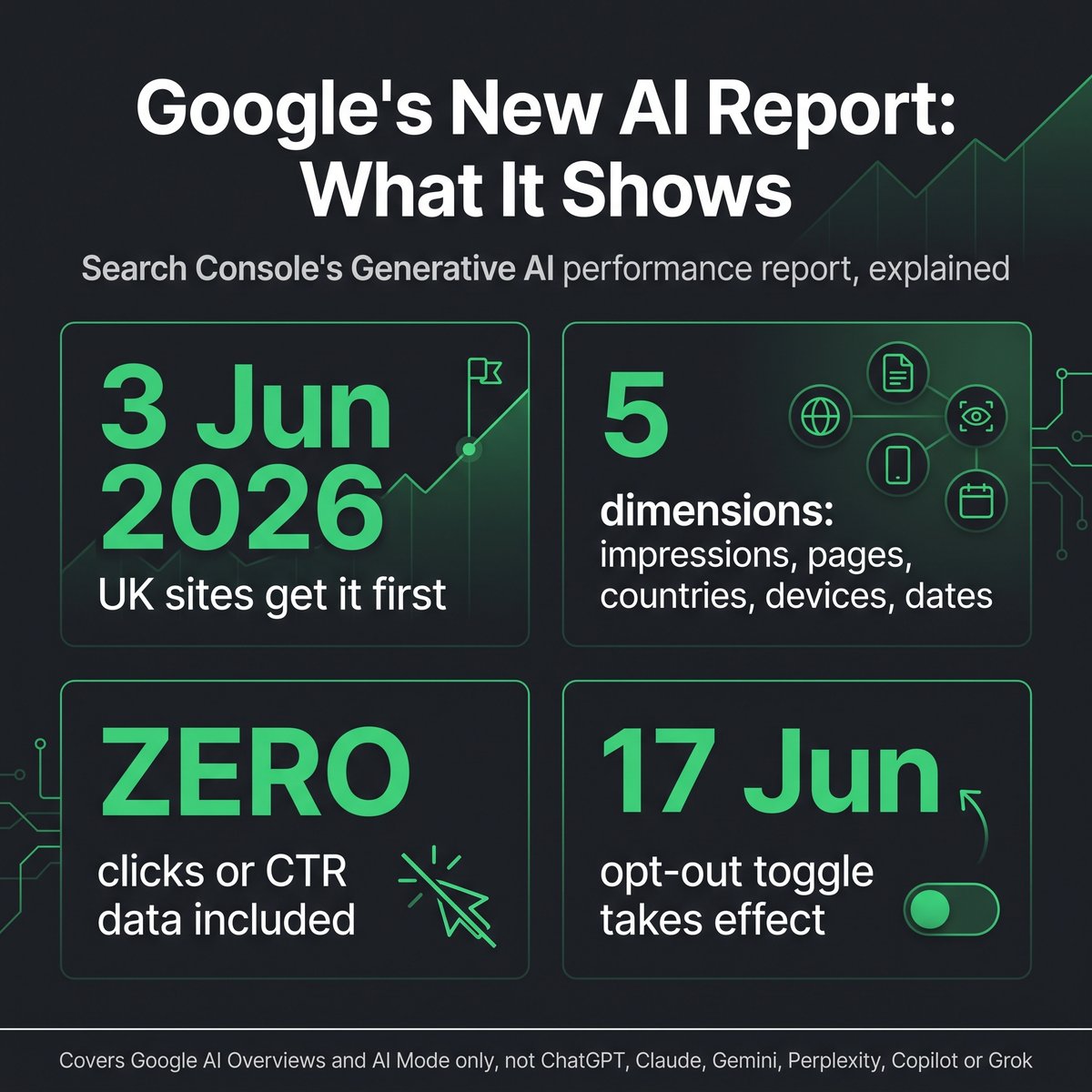
Google began rolling out a dedicated Generative AI performance report inside Search Console on 3 June 2026, and UK site operators got it first. The report shows impressions inside AI Overviews, AI Mode and generative Discover, broken down by page, country, device and date. It does not show clicks. A new opt-out toggle sits alongside it, and Google started honouring it on 17 June.
We track citation footprints for client sites daily, so a first-party impressions feed direct from Google is the kind of measurement upgrade we have been waiting for. Here is exactly where the report lives, what it does and does not tell you, and the one toggle almost nobody should touch.
Key takeaways
- Google’s Generative AI performance report launched 3 June 2026, to a subset of UK sites before any global date.
- It shows impressions, pages, countries, devices and dates for AI Overviews, AI Mode and generative Discover, but no clicks.
- The rollout followed pressure from the UK’s Competition and Markets Authority under the Digital Markets, Competition and Consumers Act 2024.
- A separate opt-out toggle removes your site from AI Overviews, AI Mode and AI Overviews in Discover, effective from 17 June.
- Opting out carries no ranking penalty on normal search results, but it also earns you nothing extra there.
- The report is a useful free baseline. It is not a replacement for GA4 referral tracking or checking the engines directly.
What actually shipped on 3 June
Google added a new section to Search Console, separate from the standard Performance report, showing how often a site’s pages appeared inside generative AI surfaces on Search and inside Discover. The dimensions on offer are impressions, the specific pages that appeared, the countries those impressions came from, the devices involved, and dates down to daily granularity where volume allows.
The rollout started with a subset of UK properties rather than every Search Console account at once, which Google has framed as a controlled test before a wider release. No global date has been confirmed. If your property does not show the new section yet, that is expected, not a bug on your end.
Why the UK got it first
The timing is not a coincidence. The UK’s Competition and Markets Authority designated Google as holding Strategic Market Status under the Digital Markets, Competition and Consumers Act 2024, and that designation came with obligations around how AI features treat publisher content. The CMA’s remit pushed Google toward giving UK publishers a genuine, working opt-out from AI-feature inclusion, not just a training-data opt-out, and the reporting change rolled out alongside it.
That regulatory pressure is worth naming because it explains a gap in the report. The CMA’s own interpretive notes say Google should eventually add click-throughs, click-through rates and a split from organic search data. None of that shipped on day one. UK site owners have visibility they did not have before, but not the full picture the regulator was pushing for.
What the report cannot tell you
No clicks, no click-through rate, no way to separate an AI Overview impression from a coincidental page-one ranking that also happened that day. You get volume and geography, not outcomes.
That gap matters because of a pattern our own client work keeps surfacing. On the Garden Ornaments case study we run on this site, organic visits went from 727 to 6,370 a month over seven months without adding new referring domains, largely on the back of pages that were already earning AI citations before we could measure the citation directly. An impressions-only report would have shown that those pages appeared in AI features. It would not have shown which of those appearances turned into an actual visit, so treat the new report as a supplement to citation tracking, not a substitute for it.
Impressions-only versus a fuller measurement stack
| GSC Generative AI report | GA4 referral tracking | Manual engine checks | |
|---|---|---|---|
| Cost | Free | Free | Free (time cost only) |
| Shows impressions | Yes | No | No |
| Shows clicks | No | Yes, where referrer data survives | No |
| Covers Google only or all engines | Google only | All engines with clean referrers | Whichever engine you query |
| Granularity | Page, country, device, date | Session, landing page, channel | Single prompt, single moment |
| Best used for | Spotting which pages Google surfaces in AI features | Confirming a visit actually happened | Confirming exact wording of a citation |
The opt-out toggle: what it does and why almost nobody should use it
The toggle removes your site from AI Overviews, AI Mode and AI Overviews inside Discover. It leaves standard blue-link search results and the regular Discover feed untouched, and Google has stated explicitly that using it carries no ranking penalty outside those generative surfaces.
Read that carefully before assuming it is a free trust signal to switch on. It is not a penalty to leave it off, and it is not a bonus to turn it on. All it does is remove you from a citation channel that is only growing. We would only recommend the opt-out for sites with a specific legal, medical or brand-safety reason to keep their content out of AI-generated answers altogether. For almost everyone else in GEO, appearing inside an AI Overview is the entire point, so leaving the toggle off is the default, sensible choice.

What the report does not cover: the other six engines
This report only measures Google’s own generative surfaces: AI Overviews, AI Mode and generative Discover. It says nothing about ChatGPT, which still carries the largest share of AI-search traffic, or about Claude, Gemini, Perplexity, Microsoft Copilot and Grok.
Treat the new Search Console data as one column in a wider table, not the whole spreadsheet. A page can climb inside Google’s AI Overviews while staying invisible on Perplexity, or the reverse. Each engine samples different sources and updates on its own schedule, so a single UK-only, Google-only report cannot stand in for checking the others directly or running a proper multi-engine citation setup.
How to use the report this week
- Check whether your property has the new section yet. Look in the left-hand navigation for a Generative AI performance entry separate from the standard Performance report. If it is missing, you are not yet in the rollout group.
- Cross-reference the pages it flags against your own citation tracking. A page appearing here without a matching AI referral in GA4 is a page getting seen but not clicked, which is worth investigating on its own.
- Leave the opt-out toggle switched off unless a named legal or compliance reason applies to your site specifically.
- Feed the country and device breakdowns into your GEO priorities. A page over-indexing on mobile impressions in one country tells you where to focus multi-engine coverage work next.
- Combine it with the free GA4 setup described in our AI citation measurement guide, so impressions and actual visits sit side by side.
Common questions
What is the Generative AI performance report in Search Console?
A dedicated report showing how often your pages appeared inside AI Overviews, AI Mode and generative Discover features, broken down by page, country, device and date.
Why did UK sites get the report first?
The report launched to a subset of UK site operators on 3 June 2026 under pressure from the Competition and Markets Authority, ahead of any global rollout date.
Does the report show clicks?
No. It shows impressions, pages, countries, devices and dates, but no click or click-through-rate data, which is the report’s biggest limitation.
What does the opt-out toggle actually do?
It removes your site from AI Overviews, AI Mode and AI Overviews in Discover only. Regular blue-link search results and normal Discover are unaffected, and it carries no ranking penalty.
Should I switch the opt-out toggle on?
Almost never. Opting out removes a growing citation channel and gives you nothing extra in classic search, so leave it off unless you have a specific legal or brand reason to hide from AI answers.
Where do I find the report in Search Console?
Look for the new Generative AI performance section in the left-hand navigation, separate from the standard Performance report, once your property has rollout access.
How does this fit with other ways of measuring AI citations?
It adds Google’s own impression data on top of GA4 referral tracking and manual engine checks, so pair it with those rather than relying on it alone.

Related reading
- How to measure AI citations: the reporting template covers the free GA4 setup that pairs with this report.
- Stop optimising only for ChatGPT: Claude and Gemini are rising puts Google’s AI features in the context of the full engine set.
- Google I/O 2026: the Search AI overhaul has the background on how Google’s AI search features got here.
Want to know which of your pages are earning AI impressions but not visits? Run the free AI visibility check. Ready to close that gap with placements on pages engines already trust? See our niche edits service, backed by a 12-month guarantee, or compare every fixed price on our pricing page.