Google Search Just Ended As You Knew It: What I/O 2026 Means For GEO

Google rebuilt Search on 19 May 2026. The keyword box is now a conversational AI search box, Gemini has a long-running Spark agent, AI Search Agents monitor the web on your behalf 24/7, and a Core Update landed in the same week. This is the largest structural change to Google Search since it launched and it changes what counts as visibility. Below is what shipped, why it matters for generative engine optimisation, and the seven things to change on your site this week.
What Google announced at I/O 2026
Google’s keynote on 19 May 2026 covered a lot of ground, but four announcements matter for anyone who depends on organic traffic.
The first is the AI Search Box, a redesigned search field that expands to fit conversational queries (the way you would talk to ChatGPT or Gemini) rather than the short keyword strings the old bar was built for. CNN Business described it as Google’s biggest change to the search bar in 25 years. Google’s own framing called it the centre of an “AI-powered overhaul of Search”.
The second is Spark, a new mode inside Gemini that runs in the background on long-lived tasks: monitoring credit card statements, watching email inboxes for important updates, building summaries and to-do lists. Spark is not a one-shot query tool. It is a persistent agent that decides when to act.
The third is AI Search Agents. These work like Spark but inside Search itself. They monitor live information across blogs, news, social, finance, shopping, and sports for changes related to a specific question, then push a synthesised update with the option to take action. Google described this as “the era of Search agents”.
The fourth, the one that matters most for site owners, is a new resource published by Google’s developer relations team on how to optimise for generative AI features in Search. The document spells out what Google’s retrieval layer rewards (non-commodity content, valuable unique information) and what its agent layer rewards (structured, real-time, citable data). It is the closest thing Google has shipped to formal GEO guidance.
And underneath all four, a Core Update that Search Engine Journal’s SEO Pulse flagged as rolling out the same week. The two changes compound. Sites that drop on the Core Update lose classic-search traffic at the moment AI surfaces start eating into the rest.
Why this is the biggest search change in 25 years
The keyword search box has been the same shape since 2000. You typed a word or two, Google returned ten links, and the work of search marketing was to be one of those ten links.
The I/O 2026 redesign assumes that buyers will increasingly stop typing keywords and start typing questions. That changes everything downstream. A conversational query like “what is the most reliable boiler service in Manchester for a Victorian terrace” produces a single synthesised answer above any list of links. The buyer reads one paragraph, sees three or four cited sources, and acts.
The economic effect is brutal and measurable. Research published in May 2026 puts organic click-through rate on AI-Overview-triggering searches down 61%, while pages that get cited inside the AI Overview see a 35% lift in organic clicks. The traffic does not disappear. It concentrates on the cited brands. If you are cited, you gain. If you are not, you lose, and the gap widens every quarter.
Spark and AI Search Agents extend this further. They are not even querying on demand. They run continuously in the background and notify the user when something material changes. The brands those agents trust as ongoing sources of truth (dated, structured, citable) become invisible defaults inside the user’s life.
Old Google Search vs new AI-powered Search
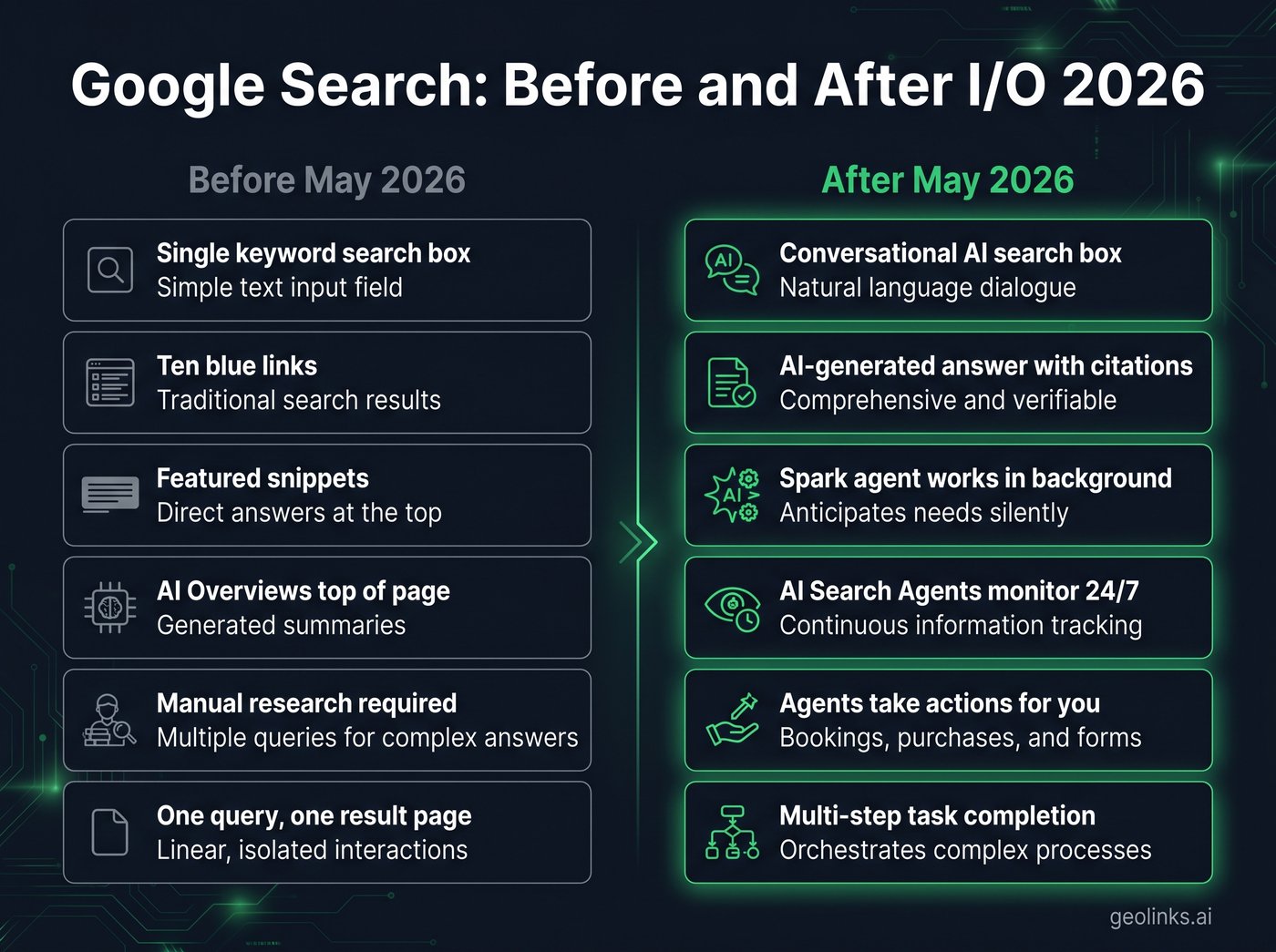
| Attribute | Before May 2026 | After May 2026 |
|---|---|---|
| Search input | Short keyword strings | Conversational long-form queries |
| Result format | Ten blue links | AI-generated answer with 3 to 5 cited sources |
| User journey | Click through, read, decide | Read the synthesised answer, optionally drill into a source |
| Background activity | None | Spark and AI Search Agents run 24/7 |
| Source visibility | Page title plus snippet | Brand name and citation, sometimes without a click |
| Winning play | Rank in the top 10 | Be one of the cited sources in the AI answer |
The thing to notice is the bottom row. Ranking and being cited are not the same job. A page can rank #3 organically and still be skipped by the AI Overview if it is text-only, not multimodal, or last updated in 2024. Citation is the new ranking.
The Core Update that landed in the same week
Search Engine Journal’s SEO Pulse coverage of the I/O 2026 search overhaul reported a Core Update rolling out at the same time. That makes it the second Core Update in three months, after the March 2026 update that introduced six new ranking gates (Information Gain, verifiable authorship, topical coherence and three more).
Two compounding effects show up in real client data. First, sites that drop on the Core Update lose ground in classic Search at the same moment the AI surfaces take a slice of the remaining traffic. Second, the AI surfaces themselves use the Core Update’s signals as a filter on what to cite. A page that lost trust on the Core Update is twice as unlikely to surface in an AI Overview.
The implication for any site that has not been touched since early 2026 is straightforward. The recovery work is not optional. It is the cost of staying visible at all.
Seven things to change on your site this week
These are the moves that produce visible lift inside the new surfaces, in priority order, based on our own work across the GeoLinks portfolio (including the Garden Ornaments case study where content-and-on-page work alone took monthly organic traffic from 727 to 6,370 in seven months without buying any new links).
1. Add a 50 to 75 word answer block under every H1. The AI Search Box pulls answers from extractable passages. If your top-of-page is a brand statement, the AI surfaces skip you. Replace it with a direct factual answer to the most likely buyer question. Use specific numbers, dates and named entities.
2. Multimodal everything. Recent research puts the correlation between multimodal page elements (images, video, charts, embedded tables) and AI Overview selection at 0.92, the highest of any single ranking factor measured in 2026. Text-only pages now lose to pages that mix formats. Add one image, one chart, and at least one comparison table to every commercial page.
3. FAQ schema and inline citations. Pages with structured FAQ schema and inline source citations are weighted roughly 40% higher in ChatGPT source selection. The same pattern shows up in AI Overview research. The FAQ section also doubles as direct answer fodder for Spark when it monitors your topic.
4. Update dates that mean something. Content updated inside the last 30 days receives more than 3x the AI citation rate of content older than 90 days. Refresh priority pages at least quarterly. Add a visible “updated” date to the byline. Replace stat-block sources with the latest data each time.
5. Get on Trustpilot, G2 or Capterra. Sites with active profiles on review platforms have roughly 3x higher ChatGPT citation probability than sites without. The reason is that the retrieval layer treats review-platform presence as proof a brand is real, active and verifiable. This is now an SEO move, not just a reputation move.
6. Cross the topical coherence threshold. The March 2026 Core Update’s Cluster-1 gate is now compounded by the AI surfaces’ preference for sites that read as authoritative on one topic, not generalists across many. Every new page needs to slot into a defined cluster, link inwards to the relevant pillar, and link back out to 3 to 5 supporting pages.
7. Add a named author with verifiable external credentials. Author-1 from March 2026 is now a hard prerequisite for citation in any of the AI surfaces. Anonymous “Editorial Team” content gets filtered out. The byline needs a real human name, a linked bio, and at least one external profile (LinkedIn, professional body, published work).
What this means for GEO budgets in 2026
The honest answer is that the I/O 2026 changes do not raise the cost of doing GEO. They raise the cost of not doing it. A site that ignores the redesign loses visibility on both surfaces (classic Search and the new AI ones) and the loss compounds month over month.
Our public starting point is a £1,250 Authority Blueprint. Managed authority programmes begin at £4,000 monthly with a three-month commitment. Useful research, content and editorial authority need enough time and budget to work together. Nobody can price delay accurately without a commercial baseline.
If you want to know where your brand actually stands right now across ChatGPT, Perplexity, Gemini, Claude and AI Overviews, the free AI Visibility Check scans all five engines in under five minutes and emails a full report. No credit card. No sales call. It will tell you whether the seven things above are urgent or whether you have time to plan.
Useful background reading
- GEO vs SEO vs AEO vs LLMO: the plain-English glossary. What each term actually means now that the surfaces have split.
- How to choose a UK GEO agency: the buyer’s framework. Seven weighted criteria for vetting providers, including the post-I/O 2026 checks.
- Best UK GEO agencies 2026: the honest ranking. Comparison of 15 UK agencies on the same rubric, GeoLinks ranked fourth on its own scoring.
- Garden UK case study. Zero to DR 15 and 149 referring domains in 30 days on a fresh domain.
The 25-year-old search bar is gone. The new one rewards a fundamentally different style of page, a fundamentally different cadence of update, and a fundamentally different distribution of authority signals. The seven moves above are the minimum viable response. If you want help running them properly, our pricing is published, every link comes with a 12-month replacement guarantee, and you can start without speaking to a salesperson.